

As the global smart home lighting market accelerates toward personalized, dynamic ambient experiences, B2B buyers—including lighting importers, brand owners, regional distributors, and commercial project contractors—face a critical hardware decision: choosing between traditional Standard RGB and advanced RGBIC (RGB Independent Control) technologies.
While standard RGB remains cost-effective for static background illumination, RGBIC has emerged as the definitive technical benchmark for premium smart floor lamps, architectural ambient lighting, gaming setups, and interactive hospitality environments. This technical white paper provides a comprehensive analysis of circuit architectures, IC protocol performance, signal degradation engineering, smart ecosystem stability, EU environmental compliance (SGS-verified PPWR), and OEM/ODM manufacturing considerations to guide strategic B2B procurement decisions.
1. Architectural & Functional Differences: RGB vs. RGBIC
To evaluate hardware performance in modern commercial and residential smart home integrations, procurement teams must look beyond initial unit BOM costs and evaluate pixel control resolution, dynamic responsiveness, and long-term circuit durability.
| Engineering Parameter | Standard RGB Lighting System | Advanced RGBIC (Independent Control) System |
|---|---|---|
| Circuit Design | All LEDs connected in parallel across global R/G/B channels | Integrated IC micro-drivers onboard or per LED segment |
| Pixel Addressability | Non-addressable (Whole strip changes as a single zone) | Fully addressable (Segmented / Pixel-level independent control) |
| Color Rendering | Single uniform color displayed across the entire fixture | Multiple distinct colors displayed simultaneously along one line |
| Dynamic Capabilities | Basic breathing, global flashing, static color selection | Chasing effects, flowing water, segmented dimming, music sync |
| Power Distribution | Uniform current load across common anode/cathode lines | Variable dynamic current load requiring stabilized IC voltage |
| Primary B2B Target | Budget accent lighting, basic shelf lights, backlight kits | Smart RGBIC floor lamps, ambient towers, commercial displays |
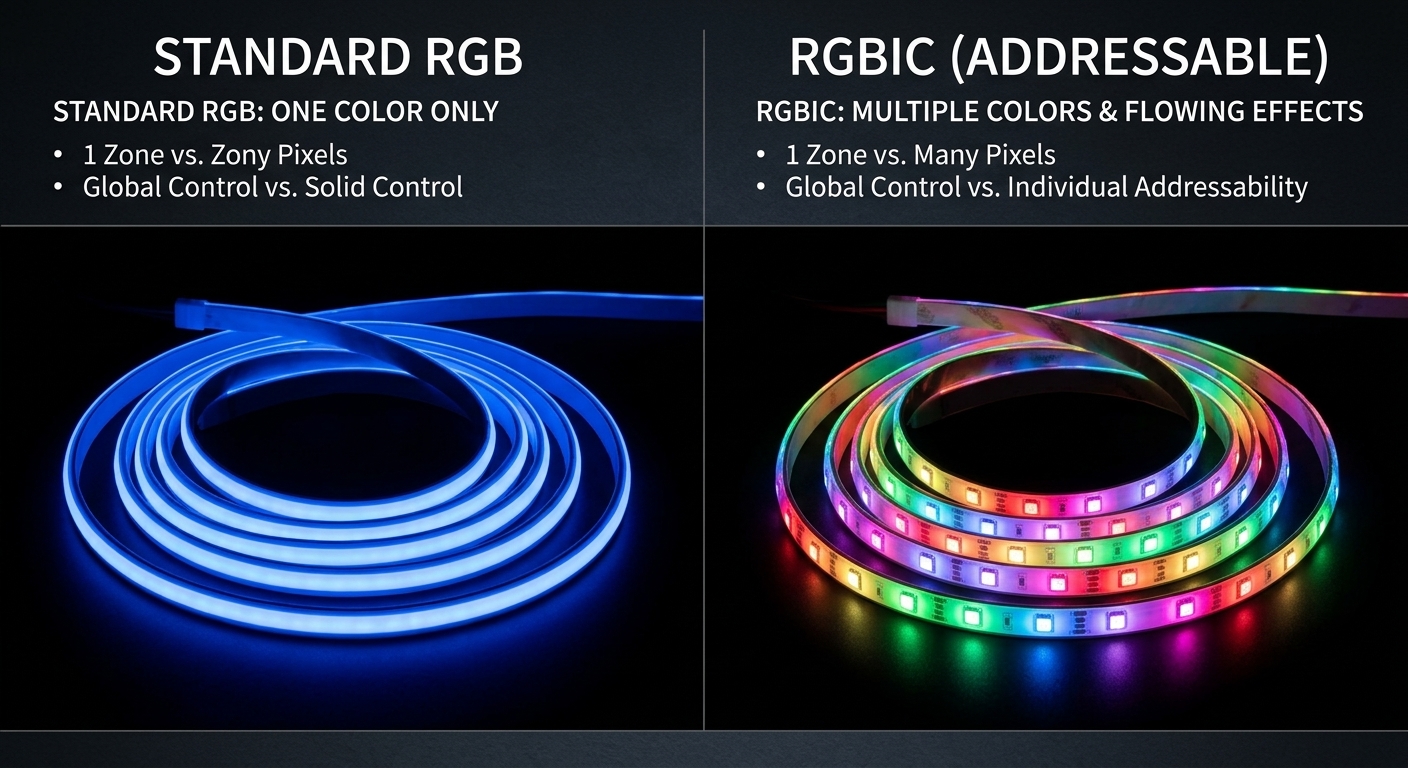
Technical Takeaway for Procurement Managers: Standard RGB lighting architecture restricts smart home automation to elementary ON/OFF states and static single-color scenes. In contrast, RGBIC technology enables individual pixel mapping. This permits smart home application platforms (Tuya Smart, Smart Life, Matter, Home Assistant) to render complex visual scenes, organic ambient gradients, and real-time audio spectrum visualization demanded by modern tech-savvy end consumers.
2. Integrated Circuit (IC) Driver Protocols & Signal Integrity Analysis
The operational stability and failure rate of an RGBIC luminaire depend directly on the chosen IC driver protocol, data transfer rates, and noise-suppression circuit design. Selecting an inappropriate IC architecture can result in signal corruption, visible flickering, or complete downstream fixture blackout.
Key IC Driver Protocols in B2B Production:
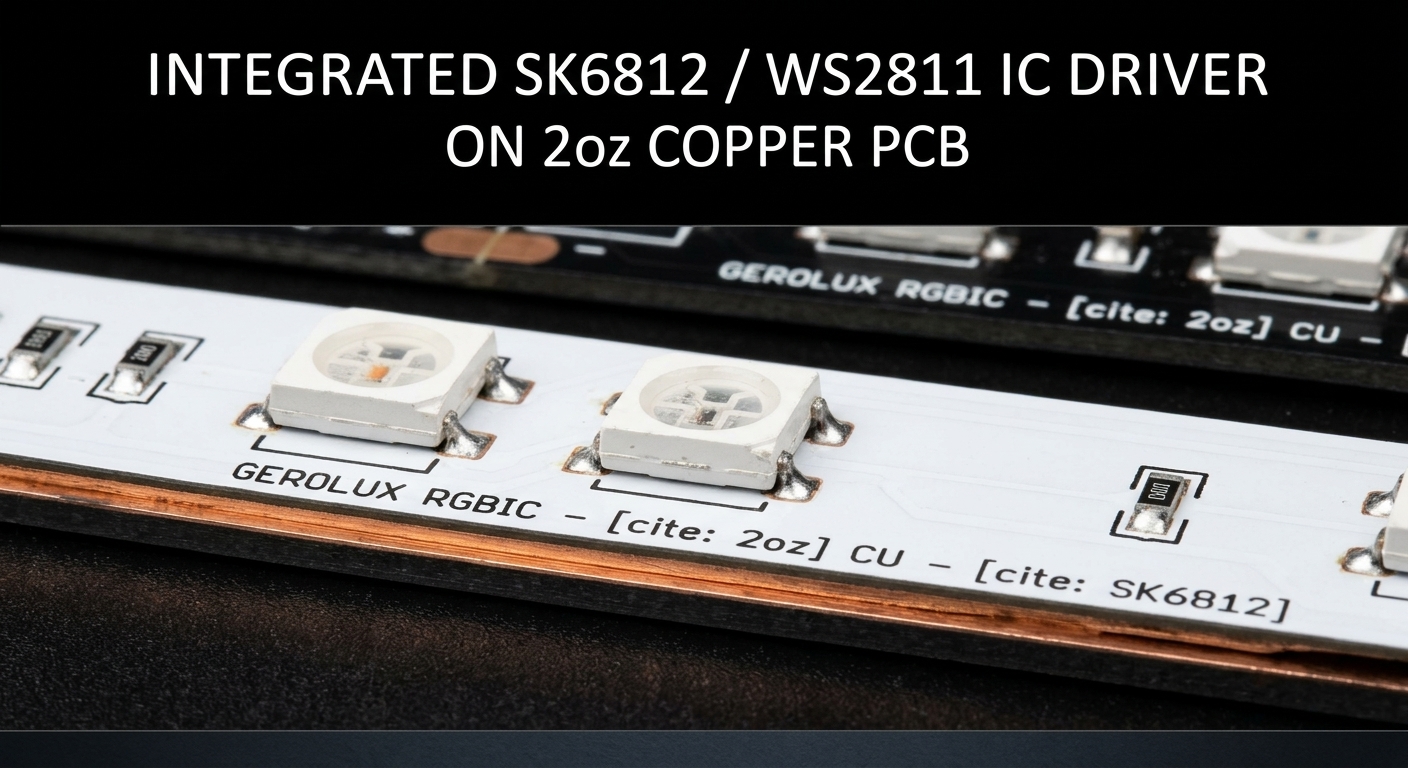
1. Single-Signal Series Protocols (e.g., WS2811 / WS2812B): Uses a single Data In (DI) / Data Out (DO) line to cascade NRZ timing signals. Cost-effective and mature, but features single-point vulnerability (if one IC fails, downstream LEDs disconnect).
2. Dual-Signal / Breakpoint Resume Protocols (e.g., SK6812 / WS2813 / GS8208): Incorporates primary and backup data lines. If a single pixel suffers hardware damage, the backup line automatically bypasses the failed IC, ensuring uninterrupted operation.
3. Clocked / High-Speed Protocols (e.g., APA102 / SK9822): Employs a two-wire SPI interface with separate Data and Clock lines. Delivers ultra-high refresh rates (>4 kHz), eliminating camera flicker in live-streaming rooms.
3. Voltage Drop & Signal Attenuation Engineering: 12V vs. 24V Systems
One of the most frequent technical complaints received by B2B importers involves voltage drop and color shifting. Understanding Ohm’s Law and conductor resistance is essential for designing commercial-grade RGBIC products.
12V DC Systems: Higher current draw per watt, leading to increased resistive heating inside the PCB trace and a max continuous run of 3 to 5 meters.
24V DC Systems: 50% lower operating current compared to 12V systems, significantly lowering heat generation and allowing runs up to 10 meters on a single power feed—making 24V the optimal choice for tall RGBIC floor lamps.
4. App & Smart Ecosystem Integration Stability
For international brand owners and retail importers, firmware stability and smart home pairing seamlessness directly dictate product return rates (RMA) on platforms like Amazon and Wayfair.
Dual-Module Wireless Connectivity: Hybrid Wi-Fi (2.4GHz) + Bluetooth Low Energy (BLE) microcontrollers for fast auto-discovery and cloud control.
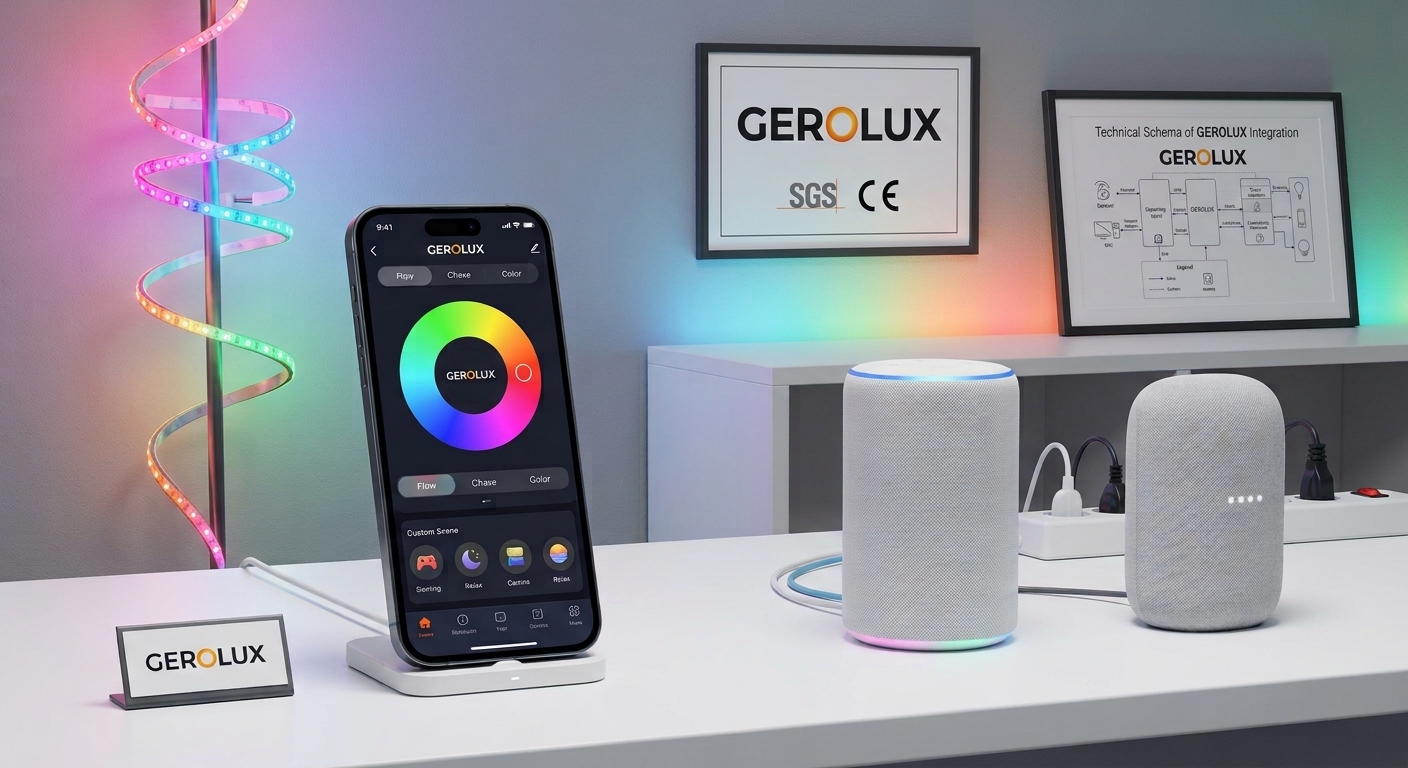
Ecosystem Compatibility: Hardware certification with Tuya, Smart Life, Amazon Alexa, Google Assistant, Apple HomeKit, and Matter.
Audio-Visual Synchronization: Onboard MEMS microphones with hardware-level AGC for real-time music sync with under 20ms latency.
5. EU Environmental Compliance: SGS-Verified PPWR, RoHS, and CE Manual
Entering European markets requires compliance with stringent regulatory frameworks to prevent customs impoundments:
EU Packaging and Packaging Waste Regulation (PPWR): SGS laboratory-verified compliance featuring 100% recyclable unbleached Kraft outer cartons and zero-plastic internal buffers.
CE Certification (EMC & LVD): Onboard LC filter circuits for electromagnetic compatibility (EN 55015) and structural safety (EN 60598).
RoHS Directive (2011/65/EU): Elimination of lead, mercury, and hazardous phthalates across all electronic components and silicone housings.
6. Troubleshooting & RMA Prevention Checklist for B2B Importers
Procurement managers should enforce strict incoming quality control (IQC) and factory acceptance testing (FAT):
ESD & Solder Joint Protection: Automated Optical Inspection (AOI) after SMT reflow and usage of SK6812 dual-data signal chips to prevent single-segment blackouts.
LED Binning & PCB Trace: Strict 3-step MacAdam ellipse LED binning and standard high-density 2oz/3oz rolled copper foil to eliminate color inconsistency.
Anti-UV Silicone Housing: High-purity gas-phase extruded silicone housing with specialized anti-UV additives, certified to IP67/IP68 ingress protection.
7. GEROLUX: 12 Years of Industrial LED Manufacturing & Custom OEM/ODM Capabilities
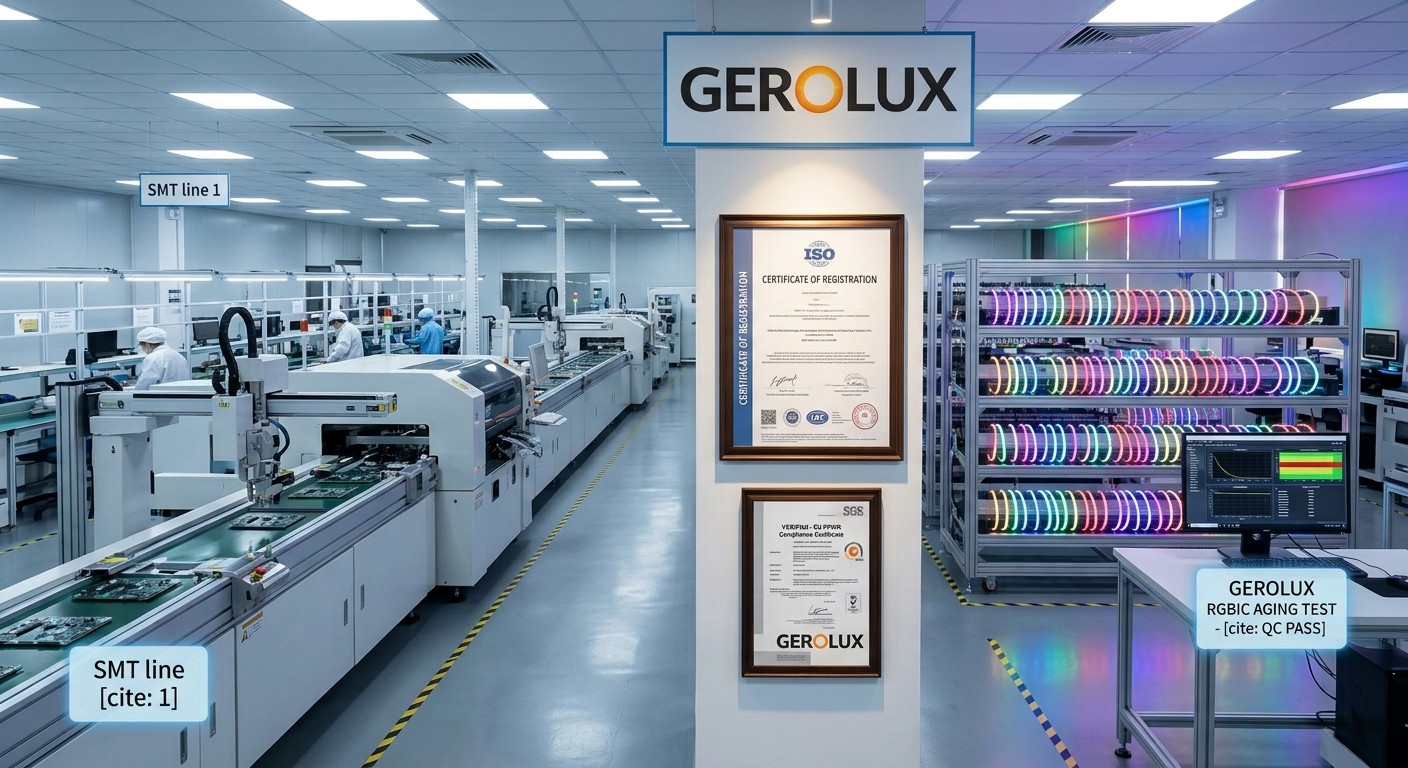
As an ISO 9001-certified source manufacturing facility with 12 years of specialized LED lighting manufacturing experience in Shenzhen, China, Shenzhen Gerolux Technology Co., Ltd. (GEROLUX) provides global B2B buyers with complete OEM/ODM solutions.
Advanced SMT Lines: Automated surface-mount technology for addressable RGBIC LED arrays.
Custom Extrusions & Tooling: 9mm ultra-slim aluminum profiles, flexible silicone neon channels, and modular smart floor lamps.
Turnkey Private-Label: Custom firmware flashing, laser engraving, and SGS-verified PPWR-compliant retail packaging development.
Rigorous Testing: 100% 48-hour continuous high-temperature burn-in tests prior to container loading.
Conclusion & Procurement Decision Matrix
Selecting between Standard RGB and RGBIC technology depends on market positioning. When specifying addressable smart RGBIC floor lamps, silicone neon flex, and cabinet lights, importers should ensure their manufacturing partner provides SGS PPWR compliance, dual-data IC protection, and ISO 9001 factory assurance.
Contact GEROLUX for Your Next Smart Lighting Project:
To request technical datasheets, sample engineering kits, or direct factory OEM/ODM quotations, contact our international sales engineering department:
Company Full Name: Shenzhen Gerolux Technology Co., Ltd.
Brand Name: GEROLUX
Official B2B Contact Email: elva@gerolux.com
Direct Sales Phone / WhatsApp: +86-18875928607 / +86-755-38865376
Official Corporate Website: https://www.gerolux.com
Factory Address: Liyuan Industrial Park, Shiyan Town, Shenzhen, Guangdong, China